CaDiCaL SAT Solver
A Modern SAT Solver Built for Speed and Simplicity
Course: Formal Methods (CS-320)
Group Members
- Faisal Iqbal Khattak
- Hassan Shahid
- Farooq Shafi
- Syed Muneeb ur Rehman Bukhari
Introduction to CaDiCaL
- What: An open-source SAT solver that checks if a logical formula can be made true.
- Who: Created by Armin Biere and his team at the Johannes Kepler University Linz.
- Why: Designed to be easy to read and modify while still being one of the fastest solvers in the world.
- Language: Written in C++, MIT license, version 2.0.
What is SAT?
SAT (Boolean Satisfiability): Given a formula made of AND, OR, and NOT over true/false variables, can we find values that make the whole thing true?
Simple Example
c Two variables (x₁, x₂), two rules:
 Rule 1:  x₁ OR x₂      (at least one must be true)
 Rule 2:  NOT x₁         (x₁ must be false)

 Solution: x₁ = false, x₂ = true  ✓
Where is SAT Used?
- Hardware verification – checking if circuits work correctly
- Software testing – finding bugs automatically
- Scheduling – solving timetabling and planning problems
How SAT Solvers Work
SAT solvers have evolved from a simple approach to a much smarter one.
The Old Way: DPLL (1962)
- Pick a variable, guess true or false.
- If something goes wrong, undo the last guess and try the other value.
- Problem: It keeps making the same mistakes because it has no memory.
The Modern Way: CDCL (1996+)
- When a conflict happens, the solver analyzes why it went wrong.
- It learns a new rule (clause) so the same mistake never happens again.
- It jumps back directly to the real cause instead of undoing one step at a time.
CaDiCaL’s Core Loop
CaDiCaL repeats these four steps until it finds a solution or proves there is none.
Smart Search Strategies
CaDiCaL uses several tricks to search faster and avoid wasting time.
- Activity Scoring (EVSIDS): Variables that appear in recent conflicts get higher priority — the solver focuses on the “trouble spots” first.
- Phase Saving: When a variable is re-visited, it reuses its last assigned value instead of guessing fresh. This avoids redoing work.
- Restarts: Periodically wipe the current search and start again from scratch (keeping learned clauses). This prevents getting stuck.
- Inprocessing: Between restarts, CaDiCaL simplifies the formula — removing unnecessary variables and clauses to make future search faster.
Interactive CDCL Demonstration
Watch CDCL solve a small formula step-by-step. Click Step to advance or Auto to animate.
Interactive CDCL: An UNSAT Example
Now watch CDCL prove a formula has no solution — learning a clause, backjumping, and hitting a dead end.
Strengths & Weaknesses
Comparing CaDiCaL with PicoSAT across key aspects.
| Aspect | CaDiCaL | PicoSAT |
|---|---|---|
| Speed | Very fast on large problems | Moderate |
| Memory Use | Higher | Lower |
| Implementation | Complex | Simple |
| Learning Power | Strong | Moderate |
| Educational Understanding | Harder to study | Easier to understand |
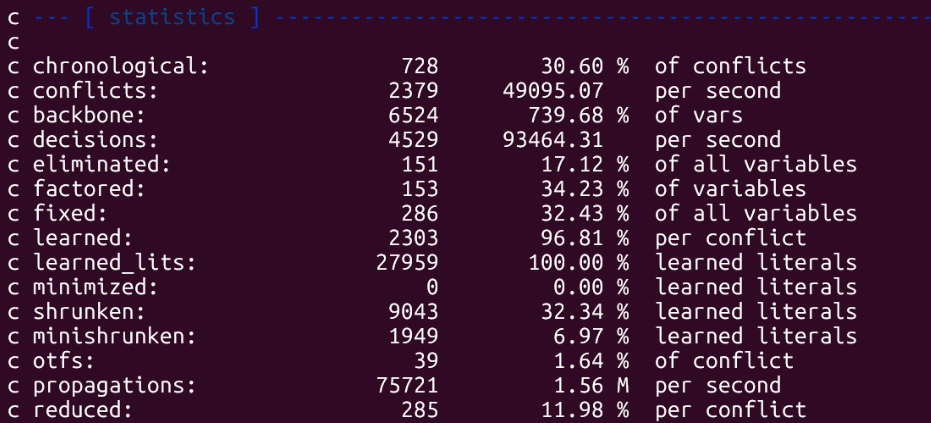
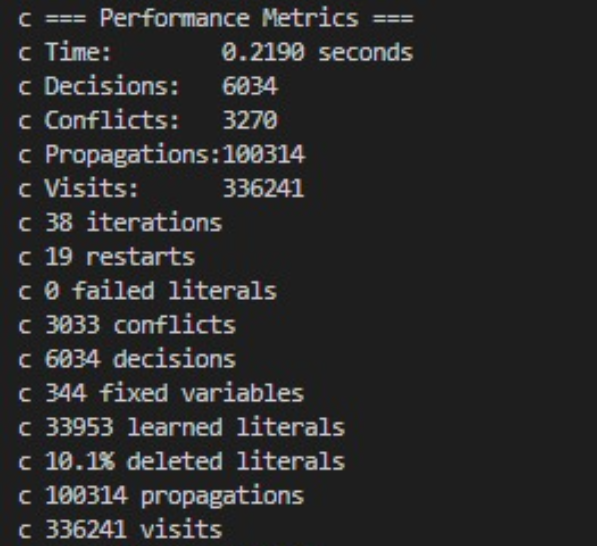
CaDiCaL Solves It Efficiently
CaDiCaL solved the problem significantly faster and more efficiently than PicoSAT.
CaDiCaL
PicoSAT
Summary & Reflections
Key takeaways from studying CaDiCaL and SAT solving.
- Clause learning is powerful: Instead of blindly guessing, CDCL learns from mistakes and never repeats the same conflict.
- Simplification matters: CaDiCaL’s inprocessing, simplifying the formula during the search, gives it a big edge over simpler solvers.
- Code quality counts: CaDiCaL shows that clean, readable code and top-tier performance are not mutually exclusive.
- Real-world impact: SAT solvers like CaDiCaL are used inside hardware verifiers, SMT solvers, and proof checkers worldwide.
Thank You & Questions
CaDiCaL is easy to understand and fast enough to win SAT competitions.
References
- Working: Working of CaDiCaL explained
- CaDiCaL as CDCL: CaDiCaL's algorithm explained
- CaDiCaL Origin: https://fmv.jku.at/cadical/
- CaDiCaL GitHub: github.com/arminbiere/cadical